For the second year in a row, Carbon Waters has participated in Paris Space Week, joining nearly 1.000 participants online. The theory has been proven: with its unique properties, graphene is ready to conquer space.
With 1.000 participants, 40 conferences, and 9.000 qualified business meetings, Paris Space Week was a great success, despite the sanitary crisis, demonstrating that its attendees are willing to innovate and move ahead, especially in the space sector.
The trade show took place digitally last March 9–10, 2021, gathering the major players in aeronautics, space, and defense, as well as institutions, in order to examine the new challenges of space exploration.
Carbon Waters took advantage of the event and could thus meet big purchasers to explain them what are graphene’s many properties. While they may be small, these nanoparticles could play a big role in the years ahead in the space sector.
Recycling Rockets
Due to its ability to resist strong and physicial thermal constraints, graphene is the perfect solution to the miniaturizing of increasingly powerful electronic components. Charlotte Gallois tells us, “Not only does it facilitate the discharge of excess heat, it also ensures better temperature diffusion.”
Used as an additive,* it increases the useful life of materials by strengthening their resistance in environments that can be quite harsh, while not weighing them down.
This “super power” of graphene ticks all the boxes on the projects of several stakeholders, such as Space X and the CNES which have already shown interest. In fact, these entities want to develop reusable capsules and components. Charlotte Gallois notes, “That requires materials that are both light and ultra-resistant to corrosion, heat, and shock.”
A graphene epoxy premix is currently being tested. That premix should be the answer to improving materials’ mechanical and thermal performance.
* in paints, varnishes, polymers, and composites
The Joy of Mentoring
Last December, on the eve of his 64th birthday, Raymond Michel joined the Board of Carbon Waters. In addition to being part of the young start-up’s strategy committee, Raymond also advises the team in charge of designing the future production pilot.
Below, the portrait of a mentor who has officially retired, but still enjoys mentoring others.
You’ve had a long career, mainly in the field of chemistry.
Raymond Michel: I graduated from the ENSIACET [French graduate school] with a degree in chemical engineering, then I worked in the chemistry departments at Elf Aquitaine and Total for 22 years. I filled various roles at the factory, and then management roles at headquarters: Safety Manager, then Industrial Manager.
Next I joined Firmenich, global leader in fragrance and flavor, where I worked for 16 years, based at the Corporate Center in Geneva. At Firmenich I was in charge of Global Operations for the Ingredients Division.
This job covered industrial activities and the supply chain, improving procedures and investments. I had a team of about 700 and we operated eight factories worldwide (Americas, China, India, Switzerland, France), including the construction and kickoff of two factories in India and China.
It was an exciting challenge from an industrial and technological viewpoint, but especially from a human viewpoint!
What did you learn from managing teams that were both multidisciplinary and multicultural?
RM: Building and developing high-performance teams and organizations is the key to success! When we work together, we can rise to new challenges, support change, and evolve. That requires education and leadership.
On an international level, you have to understand and accept cultural differences, while remaining steadfast about company values (Safety, Quality, Environment, Ethics) that everyone must follow at all times.
I remember how shocked I was the first time I visited the factory construction site in India. Children were running around the site barefoot, women, who were protected only by their saris and their sandals, were carrying heavy buckets of concrete to help their husbands. I had to call an emergency meeting of the local management team to re-explain to them in no uncertain terms the company’s standards and values, to put a stop to these slipups.
You retired in September 2020. Why get involved in a startup like Carbon Waters?
RM: I’ve always liked sharing and passing on my expertise and my experience. Carbon Waters is a very innovative French start-up that needs to industrialize to grow.
Their team is young, competent, and energetic, and I can help them develop, grow, and succeed. It’s a new challenge that I find very stimulating, both intellectually and emotionally.
What is your role within Carbon Waters?
RM: I just joined the board and I take part in the company’s strategic and organizational decision-making, particularly in industrial areas. I also spend part of my time helping Carbon Waters experts with their future production unit project.
It’s team work, where everyone contributes their expertise and their experience for the common goal of making Carbon Waters a success!
So I’m living an active retirement, between Arcachon and Pessac, family and team work, kitesurfing and nanomaterials.
To date, recommendations on graphene characterization have been drawn up, with a view to global standardization.
Graphene Quality : A key factor
Although most graphene producers provide technical data, the studies are difficult to compare and it is impossible to know whether measurements are carried out systematically.
As a result, there is a distinct lack of transparency as to the quality and price levels of graphene producers. This makes it very difficult for a potential user to identify a serious graphene supplier.
Research conducted by the National University of Singapore (NUS) has proposed an analysis and comparison protocol, based on the study of graphene quality from 60 manufacturers. Results: graphene is generally of poor quality and not optimal for many applications.
The study tends to show that most graphene manufacturers produce graphite microplatelets, not graphene. Several local initiatives have taken shape, in order to develop graphene quality verification programs. In Europe, this work is settled up in cooperation with the LNE, INERIS or NPL.
Quality assessment
1 – Ultraviolet–visible spectroscopy (UV-Visible)
With only absorbing 2% of the visible light, one layer of graphene is transparent to the human eye.
Graphene absorbs however at a very characteristic wavelength in the ultraviolet range. It is well described in the literature that pristine graphene exhibits a characteristic absorbance peak at 269 nm. This peak can be attributed to π -> π* transitions of aromatic C bonds.
Graphene oxide on the other hand has numerous defects and functional groups that interrupt the electronic continuity within the honeycomb structure.
Therefore, more energy is required for π -> π* transition of the aromatic C bonds, explaining why the absorbance peak is shifted to shorter wavelengths.
The shoulder found at 300 nm is described in the literature as n -> π* transitions of the carbonyl groups typical of graphene oxide.
The UV-Visible spectroscopy is a very simple tool to get a first idea of the quality of a graphene dispersion and to investigate the stability over time.
2 – Raman Spectroscopy
Raman spectroscopy is the main technique to consider when assessing graphene quality.
Since the discovery of graphene in 2004, many research groups have been working to decipher its Raman spectrum and extract all the information available. It is a difficult task, requiring real expertise to interpret the data correctly.
From a more simple point of view, the three main modes already provide many information about the quality of the material. In general, intensity ratios and Full Width Half Maximum (FMWH) provide the information needed to assess graphene quality.
- G mode is the reference of all comparison because it represents the carbon honeycomb structure of graphene.
- D mode is sensitive to faults and functional groups.
- 2D mode is very sensitive to the thickness of the graphene.
The Raman spectrum of graphene oxide (GO) is evidently different compared to graphene, due to the presence of numerous functional groups.
Graphene applications
It is important to remember that the efficiency of graphene in different applications relies directly on its structure and properties as shown on the figure presented below.
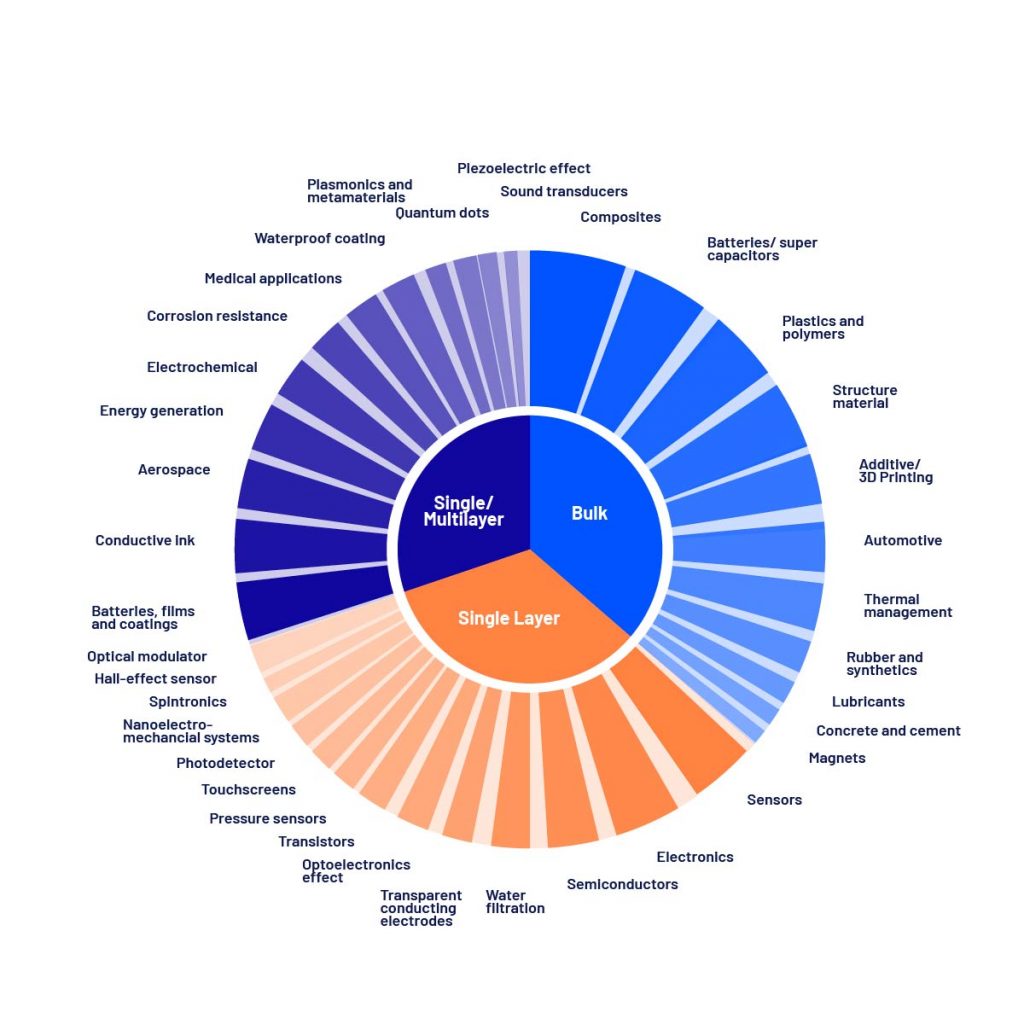 Source: the Graphene Council
A nanorecipe to make a great onion stock and other graphene bouillons
Hello everyone!
Today I am offering you a cooking mainstay: onion stock, the essential ingredient used to enhance the flavor of so many recipes.
When it’s peeled correctly, graphene is an additive that can be used sparingly to enhance the mechanical, thermal, barrier, or electrical properties of many materials, such as polymers, composites, oils, concrete, and more.
So how do you get from the raw material of graphite to graphene that is stable in water?
Here is our recipe for a delicious, well-peeled graphene stock.
First, the ingredients:
You’ll need some good quality graphite, salt, and water. And that’s all!
The salt ions are released in the water, thereby stabilizing the graphene. Otherwise, the layers of graphene tend to restack, losing all their flavor.
Preparation, the critical stage:
Salt the graphite and stir until it turns a nice golden color. Next, add one full cup of solvent and let sit till the layers of graphene separate nicely. Then strain the stock to remove any remaining lumps.
Lastly, the cooking stage:
Simmer slowly over low heat to remove any extra solvent and develop the full graphene aroma, until you obtain the famous Graphene Water. The water will retain its flavor for over six months, even at room temperature.
There you have it—the perfect ingredient to spice up the performance of your materials. At Carbon Waters, we pour a little of it into everything. It’s a real treat!
Go on, help yourself! No need to use this innovation in moderation!
Carbon Waters’ new anticorrosion Masterbatch made of preformulated graphene will hit the building and construction market in 2021.
The Masterbatch has received support from both the Ministry of Research and a European program. Read more about this product focused on respecting humans and nature from Alban Chesneau, CEO of Carbon Waters.
After two years of R&D, Carbon Waters is marketing its first anticorrosion Masterbatch. Manufactured in Pessac (Nouvelle-Aquitaine region), of preformulated graphene. The concentrate offers a durable, high-performance solution for building and construction professionals.
As CEO Alban Chesneau explains, “Most anticorrosion products on the market are made from zinc. Zinc is unstable in water, and has proven to be highly toxic to aquatic fauna.
Unlike traditional formulations, our product is concerned with respects for humans and the environment. It contains no organic solvents and no additives, and it remains stable for several months at ambient temperature.”
A Durable, Local Supply Chain
Another major advantage is that the graphite used by Carbon Waters comes from Germany, where it is made synthetically. This preserves natural graphite resources. “It’s a real benefit, because zinc-based formulations depend mostly on Asia, which holds 60% of deposits.
The health crisis has highlighted all the flaws in relying heavily on Asia for supplies and manufacturing,” says Alban Chesneau. “Now more than ever, it’s important to have a closer, more durable supply chain.”
One to Five Tons per Month by 2022
Two industrial paint manufacturers are currently testing this new solution, while nearly a dozen more are entering the testing phase on our products in the first quarter of 2021.
Discussions are also underway with the railroad, maritime, and aeronautics industries. “Requirements are very strict in these fields, and we are working together with several R&D departments to continually improve the performance of our process,” adds Alban Chesneau.
At the same time, the product’s life cycle will be analyzed and its recycling potential studied in order to become a leader in nanomaterials eco-design. This is a worldwide first for a graphene-based product.
This first year, Carbon Waters is planning on a production capacity of 20-30 liters/month. Then it will ramp up, with a goal of one ton/month within 18 months. Sizeable investments will be made over the course of the year to achieve this.
A nanorecipe to make the best homemade mint syrup and other cooling liquids
Hello everyone!
Today I am giving you the nanorecipe for homemade mint syrup. It’s so refreshing, especially when you jazz it up with Grandma’s secret ingredient.
Cooling liquids are used in numerous types of equipment, like in airplanes, for example, or in the servers that allow us to watch our favorite shows.
These liquids prevent equipment from overheating and stop the occurrence of hot spots that can damage this very useful equipment. The liquids are often oils with additives generally used to optimize various properties, depending on the application in question.
But as usual, there are limits, particularly in the thermal performance of the oils.
Here is our nanorecipe. It’s so simple, but so effective at preventing “hot flashes”!
First, the ingredients:
You’ll need oil, mineral oil for example, probably already additized according to the application you are using it on, and an organic dispersion of graphene.
Be sure that you have already determined that the oil and the graphene dispersion are compatible. The choice of ingredients is crucial!
Preparation, the critical stage:
Mix the oil and the graphene well in the right proportions so that the graphene is well dispersed, while ensuring good stability.
Lastly, the cooking stage:
This last step involves bringing the preparation to a boil to get the perfect concentration.
Watch out, it’s cold! In fact, when properly prepared, this recipe for graphene-enriched oil will significantly increase the oil’s heat dissipation properties and thereby improve its cooling capacity.
Go on, help yourself! No need to use this innovation in moderation!
It has already been established that graphene can significantly increase the most important properties of shoes, such as their grip, lightness, or elasticity.
The sporting goods industry, eager for innovation, has swiftly become interested in graphene for its ability to improve performance in a variety of sporting goods.
Why Head uses graphene?
Head is one of the world’s leading sporting goods manufacturers. The sporting goods industry has always been an arena for tough competition. So Head has always excelled in innovation in order to keep their place among the best.
It was not surprising when Head started to develop products with graphene in 2013. Making them the first sporting goods manufacturers to work with this new material.
The move is especially remarkable since only three years had passed since Andre Geim and Konstantin Novoselov had received the Nobel Prize in physics.
In order to launch their first commercial product containing graphene, Head collaborated with Graphene-XT to develop the next generation of tennis rackets.
Graphene-XT is a graphene producer that uses a mechanical exfoliation process to obtain a powder of graphene nanoplatelets (GNP).
Comparative tests performed by Head have shown that their graphene-enhanced tennis racket is up to 30% greater in mechanical strength and up to 20% lighter.
The effect? We’ll let Novak Djokovic explain:
From racket to ski
This high-performing tennis racket is based on graphene and a composite material made of arranged carbon fibers permeated with an epoxy resin.
However, it is difficult to fully attribute the rise of these performance levels specifically to graphene. (Source: Robert J. Young, The microstructure of a graphene-reinforced tennis racket).
Head is an innovation pioneer, which is why they didn’t stop there: The next step was graphene-enhanced skis.
Skiing comes with different expectations for high-performance sporting equipment from tennis. Here, the focus is on greater flexibility, sense of glide, lightness, and grip.
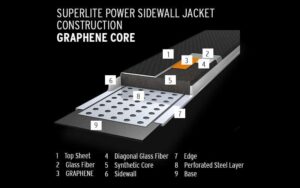
Head has developed several ski designs that integrate graphene in order to cater to these different needs. All of their skis are composed of a number of different layers. Graphene is often sandwiched between two layers of fiberglass.
In recent years, more and more graphene-enhanced sporting goods have hit the market. Just take a look at Callway’s golf balls: here. Clearly, all these different examples have one thing in common: They all use a form of graphene.
How can graphene enhance so many materials?
The fact that graphene serves as an additive simplifies its use and integration into different materials. Integrating it into composite materials, such as epoxy resin, carbon fibers, or glass, or different rubbers such as latex, is very easy.
Consequently, graphene is leading a new trend in the sporting goods industry. Because it allows for the development of new products with a true competitive edge. But the advantages of graphene are not limited to serving the needs of sporting goods manufacturers.
Due to its outstanding performance, graphene is being used by many other industries, such as aeronautics and space, to enhance their materials.
The clothing industry is also looking to develop more products like sportswear or underwear with improved properties. Currently the textile sector is investing more and more in graphene.
Graphene-enhanced fibers have better thermal regulation, and better antistatic and antifouling properties.
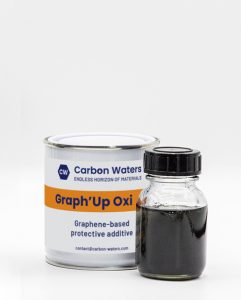 The Graph’Up Oxi range presents anticorrosion and antifouling properties
If you want to take full advantage of the possibilities graphene can offer, choose the best quality!
Charlotte Gallois has been a business developer at Carbon Waters since 2018. Her background is not what you’d expect. As a chemical PhD, Charlotte feels that working with a startup allows her to take an active role in multiple projects.
How would you summarize your career path in a few words?
Charlotte Gallois: After receiving my engineering degree at Ecole Nationale Supérieure de Chimie in Rennes, I defended a thesis on aqueous dispersions of aluminum oxide. During my doctoral studies, I had an opportunity to do research at IFP Energies Nouvelles. It was my first experience working on something other than pure academic research.
Before immersing myself in the work world, I wanted to take a step back. So I went backpacking in Asia for six months; specifically, in Chiro, Cambodia, a little village along the Mekong.
While I was there, 10,000 km from my life and my culture, I got involved with a local association. That association was operating a project to recycle plastic waste into building blocks.
This “immersive” experience, working side-by-side with the villagers in their daily lives, offered a heavy dose of ecology, economy, and innovation—the three pillars that have since been the basis of my job search.
Why Did You Decide to Join Carbon Waters?
CG: Carbon Waters is a dynamic, adaptable, proactive startup that is committed to innovative and durable projects.
Working as part of a startup team allows me to interact quickly, take part in many projects, and understand how a company works at every level. We have no work silos here. The various levels interact and the management gets involved.
What Are Your Main Missions?
CG: My main mission is to develop the projects portfolio, from assessing needs to meeting contract specifications. We currently have about 60 ongoing or upcoming projects, in areas as varied as chemistry, aeronautics, aerospace, maritime, paint formulators, and more.
I enjoy the eclectic nature of it, because each sector has its own issues, and it’s important to correctly identify their challenges and their expectations.
In addition to this double expertise in science and business, I also help to prepare multiple trade shows and events for showcasing our latest technological advances.
What Are Your Plans for 2021?
CG: The end of 2020 is looking promising. We will be participating for the first time in the Euronaval Show, October 20 to 23, at Paris Le Bourget.
Then in 2021, we will be launching our first product intended for paint formulators. It’s an anticorrosion masterbatch, with a resin and graphene base.
It’s very easy to use, and it’s compatible with traditional anticorrosion agents. This product is the first success for the Carbon Waters research unit, and we are expecting many more.
Good news for graphene in aeronautics and space travels!
“Terribly enthusiastic!” That was how Richard Branson, media darling and director of Virgin Galactic, reacted to the potential of graphene in aeronautics and space travel. Faced with increasing environmental constraints, the aeronautics industry is actively looking for ways to remove weight while increasing the structural strength of aircraft.
A key priority for the space sector is maintaining full functionality under the most extreme conditions. Graphene is an extremely lightweight material with excellent electrical and thermal conductivity. It is therefore one of the most promising solutions we have today.
Richard Branson’s enthusiasm is shared by Carbon Waters. And it is supported by two excellent pieces of news that enhance our prospects.
Intergrating aeronautics and space
The first piece of good news is that Carbon Waters has joined the ESA BIC (European Space Agency Business Incubation Centre).
This one-year project will help us to bring our protective surface treatments to technological maturity. Therefore, our design office will work alongside experts from ESA on real-world industrial electroplating studies. This new development will complement our more traditional surface treatments.
The second piece of good news is that Carbon Waters was selected by the Starburst selection committee for a potential partnership. Starburst is an international incubator, supporting only start-ups in the fields of aeronautics and space tech.
Our pitch offered us the unique opportunity to showcase the potential of our products. We shared our vision to an audience of 150 industrialists, investors, and institutions, all specialized in aerospace and defense.
Hugely successful, Carbon Waters was selected by the members of the committee as one of the top three companies. The potential for new partnerships was what made us really stand out. Moreover, Starburst and Carbon Waters are currently discussing ways to accelerate our progress, including new contacts with industrialists and investors.
Following Carbon Waters’ inclusion in the Aerospace Valley Competitiveness Cluster, these achievements mark the next step in our expansion into aerospace and aeronautics.
The best material for aeronautics & space
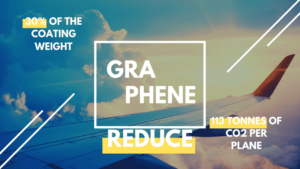
Overall, one of the largest costs to operate an airplane is fuel. Specifically, fuel accounts for 21% of operating costs.
Estimations demonstrates that thanks to its lightness, graphene reduces the weight of the coatings by 30%. Therefore, reducing the emission of CO2 by 113 tonnes and reducing the cost of several millions euros for a mid-size airplane company.
Due to its many advantages, graphene offers the aeronautics industry the opportunity to tackle financial and environmental issues at the same time.
UPDATE: Following recent sanitary events (COVID-19), this 2020 edition of Euronaval will be online.
Carbon Waters is proud to be selected at the SEAnnovation space during the Euronaval trade show. For this occasion, Carbon Waters has been able to promote its innovative technologies.
For over 50 years, Euronaval has been the world’s biggest meeting place for innovation and naval technologies of the future. It is a select location where international industrialists and purchasers in the naval industry from five continents come together.
With an eye to the future, the show is also intent on highlighting startups as the core of the sector’s innovation and agility. For this reason, it is offering the SEAnnovation area, created in partnership with Starburst and the Groupement des Industries de Construction et Activités Navales (French Marine Industry Group, or GICAN). This window on technology is also supported by Naval Group.
The form of graphene innovated by Carbon Waters has made the semimetal’s limitless applications possible on an industrial scale. More particularly for the anticorrosion applications. The company’s cutting-edge developers have once again been rewarded, with this promotion at SEAnnovation.
Says Charlotte Gallois, “It’s a great opportunity to present our innovations to the main decision-makers and industrialists the world over, and we can’t wait to take part in Euronaval!”
“Graphene has a unique performance in terms of anticorrosion, antifouling, and improving thermal and mechanical resistance properties. The benefits for the naval industry are infinite. Carbon Waters is anticipating strong growth in its activity in this strategic sector,” she adds.