In a context where the transition to more sustainable, environmentally-friendly construction has become a priority, the integration of innovative materials and disruptive technologies plays a crucial role. Among these materials, graphene is a promising solution for revolutionizing the building sector. In this article, Carbon Waters takes a look at the current state of play in the building sector, and explains how graphene and its many properties can help to decarbonize the industry.
What roadmap for the building and construction sector?
A building emits CO2 at two stages in its life cycle:
- During construction,
- During use, notably through energy consumption.
According to ADEME, “the impact on the environment is particularly marked at the time of construction, as the bulk of a building’s CO2 emissions and resource consumption are linked to its construction phase“, representing over 75% of a building’s total CO2 emissions over its life cycle.
According to the current French National Low-Carbon Strategy (SNBC-2), France’s roadmap for reducing the sector’s environmental impact, “the carbon footprint of the building value chain represented 153 Mt CO2 in 2019, or 25% of France’s annual carbon footprint.”
For the coming years, this roadmap calls for a two-stage reduction in carbon emissions:
- -48% by 2030,
- -81% by 2050, i.e. almost complete decarbonization.
In terms of materials, construction products account for almost a third of greenhouse gas emissions in the building sector, and cement is responsible for almost 10% of global emissions. The use of innovative, less polluting materials is therefore one of the solutions envisaged to reduce emissions during the construction phase and achieve the targets set by the SNBC-2.
What is the environmental impact of cement and concrete?
Cement is one of the main materials used in building construction. It is widely used to build foundations, walls, slabs and structures, thanks to its strength and durability. After water, cement is the second most consumed material in the world: fourteen billion cubic meters of concrete are poured every year (source : Global Ciment and Concrete Association).
However, its environmental impact is far from neutral. The main cause associated with cement production today is linked to the production process for clinker, an essential component of cement. To obtain clinker, limestone and clay are heated to a very high temperature (around 1400°C) in a cement kiln or calciner. However, during the heating process, the clinker releases carbon dioxide, so that to produce one ton of cement, the firing stage alone generates almost one ton of C02.
So how to reduce the use of clinker to obtain a concrete that performs just as well?
Alternatives are being standardized to replace traditional concrete. For example, low-carbon concrete contains less clinker, some of which is replaced by limestone, calcined clay or fly ash.
How can graphene help decarbonize tomorrow’s construction industry?
As mentioned above, the use of innovative, less polluting materials is essential if France is to reach the thresholds set by public policy. Indeed, this is what the sector’s roadmap states: “the increased use of low-carbon components that are not today’s standards (innovative and low-carbon products) […], appears to be an essential lever for achieving the objective of decarbonizing the building industry“.
Graphene, a material discovered just 20 years ago with a wide range of properties, can also replace part of the clinker used in buildings, thereby reducing CO2 emissions.
Integrating graphene into concrete would mean using less material, while offering similar or even better performance than traditional concrete. According to scientists at the University of Exeter, graphene concrete is twice as strong and four times more impermeable than traditional concrete.
In collaboration with the Graphene Engineering Innovation Centre (GEIC) at the University of Manchester, Nationwide Engineering has developed an admixture that enhances the performance and durability of concrete.
The very first graphene-enriched concrete slab was laid in England in a local gymnasium three years ago.
Graph’Up Force W: a range of graphene-enriched additives to reduce CO2 emissions of buildings
Carbon Waters has developed Graph’Up Force W, graphene-based additives specifically designed to reinforce cements and concretes. Available in waterborne form and incorporated directly into cement during the mixing stage, these additives enhance the mechanical performance of final materials:
- +70% Young’s modulus,
- +20% tensile strength.
For industry professionals, this is an innovative, sustainable solution that significantly reduces the amount of clinker required, without impacting material quality.
Beyond reducing environmental impact, what does graphene bring to the building sector?
In addition to its role in decarbonizing the construction sector, graphene offers many other advantages.
Firstly, graphene has excellent mechanical reinforcement properties, making it effective even at low concentrations. Thus, replacing part of the clinker in cement with graphene reduces the total amount of material used. As a result, raw material costs and, ultimately, overall construction costs are reduced.
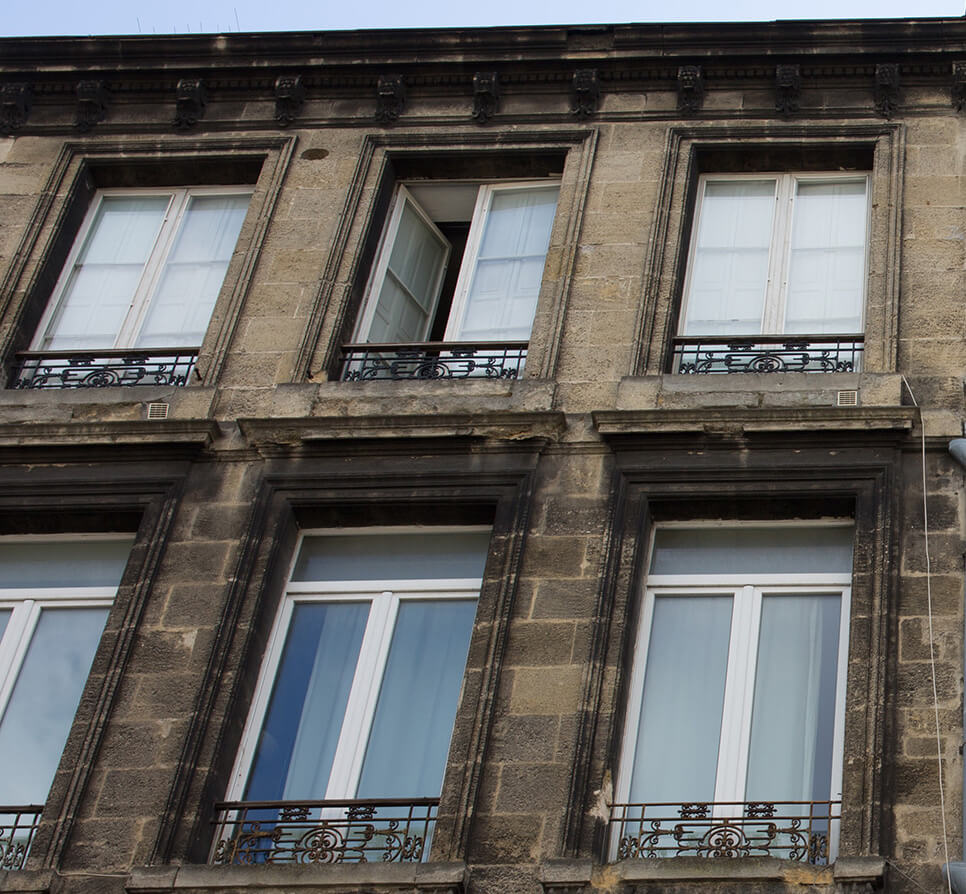 Graphene has antibacterial properties to protect building surfaces
Secondly, graphene has very interesting properties for protecting building facades from weathering and damage (through its incorporation into coatings such as paints, varnishes, etc.).
These include a powerful anti-corrosion action, a hydrophobic effect and antibacterial properties. Carbon Waters has developed Graph’Up Oxi, a range of graphene-based additives dedicated to anticorrosion, as well as Graph’Up Preserv, designed to reduce clogging of facades and thus preserve the exterior appearance of buildings.
Last but not least, the addition of graphene to building materials and coatings extends the life of buildings, reducing maintenance and replacement requirements and saving money in the long term.
Graphene represents a significant step towards decarbonizing the construction sector in France. By strengthening concrete, reducing the proportion of clinker in cement and offering a host of other benefits, graphene opens up new prospects for making the building sector sustainable. By integrating this revolutionary material into construction practices, the industry could meet its 2050 CO2 reduction targets and thus help build a more sustainable future for generations to come.
To present our performance additives to industrial customers and discuss the benefits of graphene for a wide range of materials, Carbon Waters teams were busy in March, taking part in no less than four trade shows.
Here’s a look back at this eventful month.
JEC World: the must-attend composites event
The March trade show season kicked off with JEC World 2024, held at the Parc des Expositions de Paris Villepinte from March 5 to 7. This international event takes place every year and brings together the majority of composites manufacturers, notably from the aerospace and automotive sectors. Carbon Waters was present for the fifth year running, under the collective pavilion of the Nouvelle Aquitaine region. This year’s event was a resounding success for the team, who racked up over 20 qualified meetings.
The main demand from manufacturers? Increasing the mechanical properties of polymers and composites. On the strength of the latest results obtained for its Graph’Up Force TS additives, Carbon Waters was able to demonstrate the range’s performance to companies. They were keen to test samples or to continue discussions on a possible customized study.
JEC World was also an opportunity to consolidate links with existing partners and to discuss future developments.
World Impact Summit: The global gathering for climate actions
Alongside the JEC, Carbon Waters was also present at the World Impact Summit in Bordeaux on March 7 and 8. This event aims to highlight French players developing solutions in favor of the environmental transition. Exhibiting on the startup corner of our partner CleanTech Open France, and through a pitch on March 8, Carbon Waters was able to explain to visitors how its products are part of a more sustainable industry. Indeed, our production process consumes few resources, additives can replace other products that are harmful to health and the environment (in coatings in particular), and they improve the overall performance of materials, thereby increasing their lifespan.
Techinnov: 100% innovation day
On March 26, part of the Carbon Waters team attended the Techinnov event on the startup corner, at the Parc Floral de Paris, for a day dedicated to the latest French innovations. It proved to be a fruitful meeting for our team, punctuated by around ten meetings with mainly companies from the automotive and energy sectors, as well as project managers and open innovation players.
Eurocoat: the meeting place for coatings formulators
Our teams were also present at Eurocoat on March 26, 27 and 28 at Paris Porte de Versailles. On their stand, Thomas Bottein, Formulations & Coatings Project Manager, and Nicolas Castet, COO and Product Manager for the Graph’Up Oxi and Graph’Up Preserv ranges, welcomed numerous visitors. Among them were distributors and paint formulators already familiar with graphene and its properties, and keen to learn more about our additive ranges. In addition to interest in anti-corrosion applications, they were also interested in mechanical resistance (anti-abrasion), thermal resistance and electrical conductivity.
On the second day, Thomas Bottein also gave a talk on “Graphene-based performance additives: what results for the coatings sector?“, attended by some 80 participants, many of whom then came to the stand for further information.
The month of March was marked by Carbon Waters’ very active presence on the industrial scene, confirming our major role in the development of innovative solutions to meet today’s industrial challenges. Our teams would like to thank all the companies who came to meet us at these events!
Until the next ones, contact us to tell us about your project:
After moving from Italy and then to London, Luca Bufano chose the Bordeaux region to pursue his scientific career as an Applications R&D Technician. In this interview, he looks back on his past experiences and share new challenges at Carbon Waters and his vision of the startup’s future.
I see you’re from Italy, have you moved to France recently?
Luca Bufano: Yes, I’m Italian, from Padua, a small town close to Venice. I graduated at the University of Padua as an industrial chemist before joining the R&D group of Mérieux NutriSciences in Treviso, Italy . After that, I lived for a time in England, in London, and I arrived In France just a few months ago.
Could you tell us what were your missions at Mérieux?
LB: Of course. As my first job, it was where I built my foundation in Analytical Chemistry. Mérieux works on chemical analysis and consultations on different matrixes such as food, pharma, cosmetics, and the environment. For my part, I mostly worked in the food section for big companies, such as Nestlé, aiming to develop analytical methods to qualify and/or quantify organic molecules contained in client`s products to make them respect the food regulations in EU. I learned how to work with mass spectrometry and spectroscopy and how to build an efficacy sample prep, treatment, and purification.
That sounds stimulating!
LB: It was indeed, but after almost three years, I needed a change of air and wanted to get an experience abroad. That’s why I decided to leave my country and go to the UK.
After half a year of experience in a firm dedicated to the agrochemistry field, I joined Synthomer as a material characterization scientist. Joining a company working on polymers was a challenge that I was happy to accept. It was something new for me at the time, but I was not scared because my knowledge of Analytical Chemistry could also have been useful over there.
In Synthomer I learned the science of polymers, from top to bottom. I worked in the R&D department; our research group had to analyze the client’s material and see how to improve it i.e., replacing a molecule with another. I was using different characterization methods such as DSC, TGA or GPC to understand the nature of polymers. After almost two years and a promotion to senior scientist, I decided to change again, my curiosity was still hungry!
So what has been your next challenge?
LB: In the summer of 2022, I entered as a Scientist in Pharmaron, a contract research organization that works for big pharma to provide synthetic routes and analytical consultation on different biomolecules. My curiosity to work within the Pharmaceutical Industry, another new challenge, made me join the company.
As a scientist dedicated to the Big Pharma, my role was to support with targeted analysis and the aid of NMR, HPLC-UV/Vis, GC-MS, and exact mass determination experiments on the QTof, the fate and purity of the synthetic routes developed by the organic chemist’s team for the client.
In Pharmaron I empowered my knowledge of chromatography to a deeper and more detailed level, however inside me, I was feeling the wind of change again…
Let us guess, your next destination was France?
LB: Correct! I had the will to leave London and come back to Europe. But, I must confess, it was more due to the fact I fell in love with someone from Cognac, near Bordeaux. Love is the real fire of our lives… (laughs)
What did you like about Carbon Waters that made you want to join the company?
LB: What drew my attention most in this opportunity is the fact Carbon Waters is unusual as it works on a very innovative subject: the science of graphene. As a chemist, you know that graphene exists but that’s it. Carbon Waters is one of the pioneers to understand the material and master its potential to make products out of it. That was a blast for me, so I told myself: let’s go.
Moreover, I’m happy to be committed to a company that really cares about the environment and optimizes its process to minimize, as much as possible, the impact of its final products. It is something crucial when you are doing business nowadays and I am so happy to see that the startup is committed to that.
The good choice to come here has been also confirmed by the people I meet every day: they have great knowledge of graphene and in their area of expertise (polymers, coatings, process…). Everyone is a good listener, and you can be listened too as well. Your opinion counts as the other one. That’s one of the good things about startups.
What more can you tell us about this “startup spirit”?
LB: At Carbon Waters I noticed that everyone is working together, to reach the summit. It is a step that requires time: planning and measuring what you can and you can’t do. There is a real need for the solutions we are making at Carbon Waters, so I see a “rosy future”, which in English means “bright future” for the company.
I’m very optimistic about the startup’s future and I’m very happy to be in the primary steps, as it is different from the other companies (big groups) I worked in before. It’s great to be part of the transformation of a startup.
And what about your missions in that new position?
LB: I’m a R&D technician and work with both Thomas and Lucie. Our aim, day by day, is to improve the in-house methods that produce our graphene-based additives to make them more stable and manageable if for example the initial charge of graphene is increased. We also make sure of the compatibility of graphene with our clients’ materials or matrix by conducting different tests and analyses, especially to guarantee the final product stability.
We also test the final products and evaluate their behavior with time using characterization methods, such as rheology, UV-Vis analysis, FTIR or pH analysis. These methods are similar to the ones I used in my previous experience, which helped a lot at the very beginning.
I’m glad to be working in R&D in the lab again, I feel like an investigator, using all the tools at my disposal to make discoveries, this is so great!
We can feel the passion for your job there! And on a more personal note, what do you like to?
LB: As you may have noticed, I am a very curious person. If I hadn’t be working in R&D I probably would have been a journalist! I have a passion about philosophy, art and literature. I can spend hours visiting churches, museums, or historical places. For example, if I go on a trip with my friends, they will only allow me a couple of hours to visit what I want, otherwise I wouldn’t be spending enough time with them (laughs).
I also love reading, especially novels of the 20th century. My favorite authors are Hemingway, Camus, Steinbeck, or Antonio Tabucchi, to name a few.
I do sport too, I like running, love swimming, and adore basketball, which I played for 15 years. I’m actually planning to join a team, but when the weather gets better (laughs).
Thanks for sharing all that! Would you have any last word?
LB: It can sound sickly sweet, but I am thankful to the one who believed in me the first time and made possible my moving here.
Finding a job in France when you don’t know French is very difficult and I really thank Carbon Waters for giving me this opportunity. Now my next challenge is to learn French, I cannot wait to make jokes everyone will understand (laughs).
Grazie e ciao vecci!
Faced with global warming, the aerospace industry is in the throes of a real environmental crisis, and must achieve carbon neutrality by 2050 – a considerable challenge for the entire sector.
Thanks to its multiple properties, graphene ticks all the boxes when it comes to meeting the challenges facing the aeronautics sector: decarbonization through lighter structures, but also other performance features such as lightning protection thanks to its electrical conductivity, de-icing thanks to its thermal characteristics, and equipment protection thanks to its anti-corrosion properties.
Focus on the urgent need to decarbonize the aeronautics industry, and graphene applications for lighter, more efficient aircraft.
Decarbonizing aviation: a major challenge
Air travel offers a unique combination of speed and distance covered.
However, air transport is responsible for around 3% of global CO2 emissions and almost 6% of global warming.
Faced with the urgent need to reduce greenhouse gas emissions, measures were taken at the end of 2022 by the 190 member states of the ICAO (International Civil Aviation Organization) to achieve carbon neutrality by 2050.
 Aeronautics must achieve carbon neutrality by 2050.
To achieve this, a number of avenues need to be explored:
- The use of sustainable or alternative fuels: agrofuels, hydrogen, etc.
- The development of electrically propelled aircraft
- The use of new materials to lighten aircraft and reduce kerosene consumption.
With regard to the introduction of “green” aircraft, i.e. electric or powered by sustainable fuels, this solution is not yet fully exploitable. On the one hand, developments are still in progress, and on the other, the associated costs are still very high (the price of a tonne of SAF –Sustainable Aviation Fuel– is around five times higher than that of a tonne of kerosene).
As for electrically-powered aircraft, here too the subject is not yet topical, since development work is extremely time-consuming and, for the time being, the extra weight of aircraft batteries means that medium- and long-haul flights cannot be carried out on 100% electric power (source: Safran).
What remains, then, is the quicker and less costly solution of replacing traditional materials with advanced, higher-performance and lighter materials, such as graphene.
Graphene to help decarbonize the aerospace industry
In terms of lightness, graphene makes it possible to reduce the overall weight of aircraft, resulting in a considerable drop in fuel consumption. According to Elmar Bonnacursot (Aeronautics Champion of the Graphene Flagship), “each kilogram spared saves approximately two tons of fuel, avoiding six tons of CO2 emission, over the lifetime of an aircraft.” “
According to the Graphene Council, graphene leads to a 20-30% reduction in weight, without any compromise on other expected performances. In addition, graphene has been shown to make carbon-fiber-reinforced plastics (CFRP) lighter and stronger, while offering 60% greater impact resistance. This makes graphene the material with the best mass/mechanical properties ratio.
This potential has been demonstrated by Carbon Waters on polymers widely used in the aeronautics sector, through tests carried out both internally and with several partners and customers. These results enable Carbon Waters to offer products that improve the thermomechanical behavior of composites and meet the challenge of making materials lighter, through its Graph’Up Resist and Graph’Up Force ranges.
 Graphene offers many advantages for the aerospace industry
What are the other advantages of graphene for aerospace?
In addition to its lightness and mechanical reinforcement, graphene also offers other advantages, such as excellent thermal and electrical conductivity, which can be used for functionalized coatings such as conductive paints, or to improve the performance of heat-transfer fluids. Graphene’s multi-functionality makes it the ideal material for a wide range of aerospace applications.
Graphene as an anti-corrosion performance booster
Graphene is also an excellent anti-corrosion agent, extending the life of coatings. The Graph’Up Oxi range has been specially designed for this purpose. Thanks to their barrier properties, Graph’Up Oxi additives protect all parts of the aircraft from corrosion, including those of chemical origin (kerosene, de-icing agents, etc.).
Effective on their own, they maximize anti-corrosion performance when used in synergy with zinc-added formulations. In this way, coatings can be applied in thinner layers, making aircraft even lighter.
Graphene as an integrated de-icing solution
Using the Joule effect, graphene offers a thermoelectric solution for preventing or eliminating frost, without affecting aerodynamic properties. The Graphene Flagship‘s Spearhead Project (GICE) is just one example. Led by Airbus and Sonaca, this project, which is nearing completion, aims to bring graphene-enriched de-icing systems up to technological maturity level 6 (TRL6).
Such systems will make it possible to avoid the use of chemical de-icers such as glycol on the tarmac, which are responsible for prolonged ground immobilization of aircraft. In addition, replacing traditional de-icers with another de-icing method will avoid the release of chemical compounds into the air, likely to be inhaled by people in the surrounding areas (personnel, travellers, local residents, etc.).
Graphene as a lightning protector
Today, composites incorporating copper mesh are mainly used in aeronautics to protect aircraft from lightning strikes. An effective solution, but one with a few drawbacks. Firstly, these composites increase the overall weight of the aircraft. Secondly, they are complex and time-consuming to manufacture, as the process is difficult to automate.
A lightweight material, graphene also boasts excellent electrical conductivity, enabling it to redistribute the energy received at the point of impact. This makes it an attractive solution for lightning protection systems. By replacing copper mesh in composites with conductive resins, thanks in particular to graphene, aircraft are now equipped with a lightning protection solution that is simpler to implement.
Thanks to its many properties, graphene is helping the aerospace industry to achieve its carbon-neutral objective, while offering a host of other performance benefits. In addition to the applications detailed in this article, graphene also improves the fire resistance performance of materials, while offering excellent thermal conductivity and EMI shielding.
If you have any questions about the use of graphene in the aeronautics sector:
Marianne Abib-Pech is an international businesswoman, finance expert, author, entrepreneur investor. Marianne joined Carbon Waters Board over a year ago and looks back on her career and shares how she is supporting Carbon Waters.
You’ve had an impressive career. Can you tell us a little about the early years of your professional life?
Marianne Abib-Pech: I started my career in 1996, in Arthur Andersen in Luxembourg, after studying in the UK. This first international experience was a defining moment. It shaped the rest of my career, that has been most exclusively international and in key financial centers: London, Geneva, Hong-Kong.
I always says jokingly, I already had three different lives and I am on the look-out for a fourth one!
My first life was a traditional corporate executive career that took me from audit in Arthur Andersen to the CFO position of Shell Aviation. It was a big milestone in my career and provided an extraordinary opportunity to learn and grow as a businessperson. In the short span of four years, the $20 B revenue company went through a complete strategic reformulation. It resulted in a trove of M&A activities in both mature and emerging markets.
I then authored a book on leadership with the view to share the learnings of my corporate careers with as many as possible and pave the way for a smoother journey.
These two very different parts of my life led me today as an investor-entrepreneur; I use both the creative side of writing with finance structured and risk-aware thinking.
You were one of the few women in Shell Finance leadership team?
MAP: Yes, that is correct with the likes of Jessica Uhl and Sinead Gorman who both became Group CFOs!
Diversity was at infancy level back then and Shell tried to be a pioneer in the field to nurture and promote a new generation of female leaders. It informed my leadership style, the value I see in diversity in the broader meaning possible.
More generally, my experience in oil and gas transformed perception of strategic thinking. As a deeply macro and geopolitically driven sector, it requires to look for asymmetry, play the short and the long game, with a specific risk-reward compass. It changed the way I saw the business world.
You are also the author of The Financial Times Guide to Leadership. Can you tell us more about it?
MAP: I always had a creative steak and a passion for writing. After securing the CFO position in Shell I had a bit of an existential crisis.
When you get your dream job relatively early in your life, I was 35 at the time, the “what I am going to do next?” question comes to haunt you, and having mostly worked in male-dominated industry, the gender element was also at the forefront of my questioning.
I was looking for answers. I did not find anything relatable and decided to write the book I needed myself!
I interviewed more than thirty women in leadership positions, cross-sectors, different nationalities and age group, emblematic women such as Clara Gaymard or Mercedes Erra, or less famous ones that were doing their parts … in the shadows (she laughs), like Estelle Clark for Lloyds Register who became a mentor.
All the interviews gave fantastic food for thought, a framework to reflect, learn and grow from… and I decided to try to get this published.
Serendipity stroke. Pearsons’ commissioning editor at that time received my book proposal from I believe three different sources and called. As mentioned earlier, diversity was not yet mainstream. She very diplomatically pointed to the limited financial potential of such a book and offered a more generic angle… which I then wrote.
And then you set up your own business?
MAP: Indeed, it felt like a natural next step. My finance background paired with experience in strategic formulation, market entries and equity transactions were boding well for a M&A business.
The global and macro mindset developed through my Shell experience put Iran on our radar, and we decided to bet on it. We believed the fundamentals were very strong and the moment was right.
We made several trips to the country, to get a lay of the land, understand, learn, and assess how we can have an impact and create value. After several visits to the country, we landed on two verticals, tourism and education, and soon landed mandates with high profile French players in aviation catering and Michelin-star culinary education.
And how did you come to work with startups?
MAP: Frontiers markets such as Iran are an acquired taste! They require some risk mitigation as you are hardly in control of anything!
I had started my investor’s journey around the same time mostly in tech. After a while, you develop an intuition on possible startups success– operational, funding etc. While evaluating potential investment, my corporate mindset would always come into play: who could be a customer for that startup? Who would be interested in acquiring them and who do I know?
It developed organically. It made a lot of sense to add this particular vertical to the M&A business as I was already doing it.
Can you tell us about the Transitions First (T1ST), your latest project ?
MAP: Transitions First is THE project for the next forty years! For the past two years, I’ve been interested in understanding the challenges of scale up for industrial startups.
Fast forwarding to today, and taking into consideration macro trends, economic sovereignty is now recognized as a priority, the climate challenge calls for industrial transformation challenge and requires all players (financial, public or private sector, French, European, international) to converge and act. Ultimately, venture capital has to evolve and a true industrial venture capital must emerge…
These are the foundations of T1ST concept thesis. We are an early-stage venture capital fund dedicated to accelerating industrial transition. Our purpose is to (re)building local, sustainable supply chains and change the way we produce.
We want to accelerate scale up of industrial deep tech startups, by using all the tools in the box: faster revenue generation, cost and CAPEX optimization initiatives through joint-ventures and partnerships.
We want to find, nurture and finance the best deep tech startups born from the most advanced and prestigious innovation ecosystems: Silicon Valley, Europe and Israel and fast-track them to success… and impact !
I am super excited with the fund! It is impact, international and anchored a meeting of minds, shared values and complementarity of skillset as my business partner Alic Chen is one of the founding members of UC Berkeley’s Incubator and previously ran a micro fund. The thesis resonated immediately with International groups such as South Korean giant SK Networks and Japanese investment holding Real Tech Holdings and private individuals.
Carbon Waters is a great example of what the thesis is about.
Precisely how did you discover Carbon Waters?
MAP: I met Alban Chesneau and Carbon Waters just over a year ago and invested personally.
I was impressed by the business value proposition, the technological innovation and, above all, Alban’s vision and personality. I wanted to play a role, even minimal, in unearthing graphene capabilities and driving sustainability mindset in major industries: chemical, automotive, defense, to quote just a few…. and bring diversity into the mix.
How do you support Carbon Waters today?
MAP: I am part of the Advisory Board specifically focused on financing, and growth strategy– i.e honing business model and planting the seeds for international expansion and growth.
I believe Carbon Waters is going places. Alban’s pragmatic and no-nonsense approach to business, his incredible drive to do the right things and do things right are truly impressive. Thanks to listening skills and understated yet charismatic leadership style he has the potential to drive Carbon Waters to the moon! And it is a great source of knowledge for me. So overall I am very happy to get the opportunity to help and support Carbon Waters.
Production technician Julien Perrier joined Carbon Waters a few months ago. This judo and travel enthusiast tells us about his career path, what he likes about Carbon Waters and his vision for the future.
Can you tell us about your background and experiences before Carbon Waters?
Julien Perrier: I’m originally from Bordeaux, where I did my BTS in Chemistry. Once I’d graduated, I went straight to work. I’ve been working in the chemical industry for over 10 years. I’m a very curious person, I love to learn. Before joining Carbon Waters, I wanted to get a global view of what it’s like to work in a company. That’s why I worked on a series of temporary agency contracts, in a wide variety of positions, which enabled me to work for a wide range of companies, mainly large groups such as Michelin, EDF or Sanofi, to name but a few.
And what are your chemistry skills?
JP: Through my experience, I have acquired skills in several areas: quality control, production monitoring, process development, equipment maintenance, but also scale-up, i.e. transposing a lab production process to a larger scale. My career path has made me a real “Swiss Army knife”: I’m able to adapt to any environment. I think that’s what made the difference with Carbon Waters, who recruited me in April 2023.
And why did you decide to join Carbon Waters?
JP: What really appealed to me about the Production Technician position was the possibility of working in R&D, as Carbon Waters devotes a large part of its investments to this area, in order to improve both its production process and its graphene dispersions. Before Carbon Waters, I hadn’t had the opportunity to get involved in these areas. Here, I’m lucky enough to be able to learn about them directly on the job, while contributing my know-how in other areas.
What’s your day-to-day life like at Carbon Waters?
JP: At Carbon Waters, I have a double role. On the one hand, I’m in charge, along with the rest of the team, of producing the graphene dispersions (OGD) needed for customized customer projects, as well as our finished products, which make up the Graph’Up range. On the other, I’m working on improving and developing the production process.
Indeed, Carbon Waters is starting its industrialization phase with the construction of a semi-industrial pilot plant. We therefore need to prepare for this stage by studying the systems and tools that will be best suited to it. All the teams are mobilized on this major project: Rym for process adaptation, Mahbub and Fabien for production, and also Lucie and Thomas, the Application Managers. Moving from a benchtop process to industrial-scale production doesn’t happen by chance!
What do you like about CW?
JP: I really like Carbon Waters’ state of mind, as it’s a small structure, each member of the team is accessible, and we can discuss everything. Everyone can give their point of view and that makes for very rich, complementary exchanges, especially between the production and R&D teams. What’s more, this flexibility enables us to move things forward quickly, without going through a lot of intermediaries before reaching a decision.
I also very much appreciate the trust that is placed in us, both in terms of working hours, in the sense that we can organize our work as we wish (as long as it doesn’t get in the way of the team’s work, of course), and also the possibility of working on subjects in parallel with our main missions, in which we have a particular interest. This trust also translates into responsibilities. For example, I can take care of certain appointments with equipment suppliers for the future pilot myself, something that would never have happened in a large group.
How do you see your future, with Carbon Waters or elsewhere?
JP: In a few months’ time, I’d like to go back to school and get my degree in chemical engineering. This would enable me to evolve and continue to work on R&D subjects, particularly process development, but with a greater challenge to solve difficult problems. Ideally, I’d like to do a co-op training course at Carbon Waters, as I’d like to continue to take part in this adventure, and in particular in the industrialization phase, being present from A to Z and learning a lot in the process. When you consider what graphene can bring to industry, and the technical nature of our products, you can’t help but want to take part in a project like this!
And apart from chemistry, what are your passions?
JP: I’ve been passionate about judo for years. As I’m keen to pass on my passion, I even took my sports instructor’s diploma a few years ago in order to coach young people, which I do every evening of the week. On top of that, I’m a tango dancer and occasionally take part in shows. I also enjoy permaculture, cinema and, above all, travelling! I’ve been lucky enough to visit a dozen countries all over the world. It’s a real asset to be able to immerse oneself in cultures different from our own, and to be able to exchange ideas with foreigners – it’s priceless!
Since the early 1990s, more and more wind turbines – modern windmills that convert the energy of the wind into electricity – have been blooming in our landscapes.
As part of the energy transition, the wind turbine market is expanding to offer greener energy with controlled environmental impact. According to Ademe, this energy source is one of the least polluting throughout its life cycle.
However, the sector faces a number of challenges, not least the lifespan and recycling of certain wind turbine components. Carbon Waters reports.
Significant environmental benefits thanks to wind turbines
If wind farms are multiplying, accounting for almost 10% of total electricity production in France, for example, it’s obviously with the aim of developing renewable energy sources. Whether onshore or offshore, a 2 MW wind turbine produces an average of 4,200 MWh per year, equivalent to the average electricity consumption of around 800 households in France.
What’s more, according to the International Energy Agency (IEA), wind power significantly reduces CO2 emissions. In 2020, nearly 170 million tonnes of greenhouse gases were avoided thanks to wind power.
This energy source produces electricity without polluting the environment, thus preserving flora and fauna, unlike other types of energy production such as nuclear or gas.
Issues in the wind energy sector
Despite all these advantages and the boom in the sector, it is nevertheless plagued by two difficulties, directly linked to the end-of-life of components:
- The recyclability of blades: the composite materials (glass and carbon fibers mixed in epoxy or polyester resins) currently used are not recyclable.
- The fragility of composites used for offshore wind turbines.
On the first front, manufacturers such as Siemens Energy and Arkema are working on the production of recyclable resins for offshore wind turbine blades. Siemens Gamesa, a subsidiary of the Siemens Energy group dedicated to wind power, already offers solutions through its RecyclableBlade range. For onshore wind turbines, on the other hand, the issue seems more complex, as they are built in two parts, with the glue joint posing a problem in terms of recyclability.
As far as the fragility of offshore equipment composites is concerned, current events bear direct witness to this. Recently, Siemens Gamesa suffered huge financial losses. The cause? Technical problems, mainly quality defects in the blades, leading to fractures. The world’s second-largest wind turbine manufacturer announced that 15 to 30% of its wind farm would be affected, representing over 30GW of turbines and losses of nearly $3 billion. The company’s shares fell by over 30% on the stock market.
Graphene as a solution for strengthening wind turbines and extending their service life
To overcome the problem of the quality of offshore wind turbines, which are by definition subject to severe conditions, solutions can be adopted to preserve the integrity of the materials of which they are made.
Graphene is the ideal material for enhancing the strength and lightness of wind turbine blades made from composite materials.
Carbon has already demonstrated its effectiveness in both these respects, as shown by a study carried out by Case Western University in the USA. Blades reinforced with carbon nanotubes are said to be 8 times stronger than traditional blades, and much lighter, reducing the load on turbines.
For offshore equipment, the anti-corrosion factor must also be taken into account. Here too, graphene’s excellent barrier properties help protect materials from oxidation.
In additive form, it can be incorporated directly into the resin used in the manufacture of wind turbine blades. Better protected, the materials benefit from a longer service life. When integrated into wind turbine composites, these solutions could reduce the need to renew certain wind farms, thus generating significant savings in maintenance costs.
Graph’Up: graphene-based performance additives for the wind energy sector
Following several years’ development work in conjunction with manufacturers specializing in polymers and composites, Carbon Waters has developed a range of graphene-based performance additives that respond directly to these challenges.
Tests carried out on this dedicated Graph’Up range show a very strong improvement in the mechanical properties of thermosetting polymers (epoxies), even at low concentrations:
- +30% tensile strength and resistance to deformation
- +50% stiffness
- +30°C temperature resistance (more information on request).
In addition, a qualification phase has been launched with several European companies, notably for wind power applications. In addition, Carbon Waters has initiated an R&D collaboration with a leading specialty polymers company. The aim is to use this range of additives in a very specific family of polymers to meet the challenges of recyclability for composites used in the wind energy sector.
Alain Pénicaud, Research Director at CRPP, is closely involved with Carbon Waters. Co-founder of the company, shareholder, thesis supervisor and advisor, in this interview he looks back on his career and the creation of Carbon Waters, giving us his vision and hopes for the future of the company.
Could you tell us a little about your background?
I’m a Research Director at the CNRS, where I began my career in 1988. I’m a pure university product, and proud of it. I’ve been working at the Paul Pascal Research Center (CRPP) in Pessac since 1996.
I was lucky enough to leave as a post-doctoral researcher just when the C60 molecule, also called fullerenen, was discovered. It was a colleague at UC Santa Barbara who introduced it to us, explaining that electrons could be added to make it an anion. I was immediately fascinated: I wanted to be among the first to investigate the subject. That’s why I decided to devote my postdoctoral studies to C60.
Later, I became interested in carbon nanotubes, and then graphene when it was discovered. To sum up, all the “oddities” in the world of carbon chemistry are what fascinate me: C60, carbon nanotubes and finally graphene.
How did you contribute to the creation of Carbon Waters?
Carlos Drummond and I spent several years working on the isolation of graphene using the top-down method of chemical exfoliation. In fact, the Carbon Waters story is the culmination of a long and very fundamental research process.
In the early 2000s, I had the idea that a carbon nanotube salt, i.e. a negatively charged carbon nanotube, could be soluble, unlike a neutral carbon nanotube. Pierre Petit, Director of Research at the Charles Sadron Institute in Strasbourg, had synthesized carbon nanotube salts and sent me some. We tried the experiment, notably with Brigitte Vigolo and Eric Anglaret (from the University of Montpellier), and it worked!
Later, I wanted to try the same thing with graphite. As graphene had only just been discovered, I wanted to be one of the pioneers in research into this new material and, in particular, its production process. With Cristina Vallés, then Amélie Catheline and the support of Carlos, we were the first to produce graphenide solutions!
The system was complex, since we had to work in an inert atmosphere, without oxygen or humidity, in a glove box. Then we had to be able to obtain a stable solution, even in an ambient atmosphere. Thanks to Carlos’ ideas and George Bepete’s tenacity, we succeeded!
And how did you go from research to business?
When we realized the potential of these water-stable graphene dispersions, we knew that this innovation could revolutionize the world of industry. But to do so, we had to take the plunge and create a corporate structure.
Carbon Waters is certainly a story of science, but it’s also a story of people. It was really our meeting with Alban Chesneau that changed everything. Increasingly motivated and convinced by the project, he helped us launch into this entrepreneurial phase and then fully assumed responsibility for the project by creating the Carbon Waters start-up at the end of 2017.
Are you still close to Carbon Waters and its team?
Absolutely. As well as having co-founded the company, I’m still a shareholder, alongside Carlos and Alban. What’s more, following a request to the CNRS ethics department, I’m authorized to devote 20% of my time to Carbon Waters to advise the team on various subjects. For example, I can support Rym on technology and process-related issues, or Thomas on questions concerning the stabilization of graphene in different solvents.
And you are also a thesis supervisor?
Yes, Carlos and I are working with Luna on her CIFRE thesis. Her subject is the stabilization of graphene in water, and in particular the understanding of this phenomenon. A highly interesting and important subject, both for research and for Carbon Waters, but one that requires a lot of time. That’s why it’s so important to have a PhD student fully dedicated to the subject, as the Carbon Waters technical team is already very busy in terms of R&D, production and applications.
What’s your vision of Carbon Waters today?
Today, I’m blown away by what Carbon Waters has become: 17 people in the team, a second round of funding, more and more contacts to carry out studies on industrial applications… At the very beginning of the story, we had no idea that all this would happen!
I’m very happy to be part of this fine company, which has kept its head on its shoulders from the outset, thanks to Alban. This allows us to move forward slowly but surely, which is much healthier for a company. Carbon Waters has developed extraordinary know-how, which has always endured despite the company’s arrivals and departures. Luna, for example, was able to produce graphene water in just two months, thanks to the great expertise of the team!
I’m also proud to see Carbon Waters grow. It’s starting to be well recognized on a global scale too, which helps to highlight French know-how and manufacturing.
How do you see the future for Carbon Waters?
My hope is that Carbon Waters will supply more and more coating and paint manufacturers with “clean” solutions thanks to its graphene-based products. Today, too many chromium-containing additives are used for anticorrosion – a real environmental disaster! We can protect a lot of materials with graphene, but there’s still progress to be made from an ecological point of view.
There are also existing resources for using graphite from the circular economy, which Carbon Waters is already investigating. The company has a vision of a “greener” industrial world, and is taking more and more steps to contribute to it – another aspect of the company that I really appreciate.
Chemical Vapour Deposition: The process
Chemical Vapor Deposition (CVD) is the only bottom-up production method for graphene which
is used in an industrial environment.
Here, carbon containing gases, such as methane, are brought in contact with a metal surface under high temperatures (1000°C) and high pressure. Subsequently, the graphene honeycomb structure is formed on the metal substrate which serves as a catalyst.
Advantages and drawbacks
Even though the quality of the so produced graphene is high, being mostly SLG graphene with very little functional groups or defects, this production method has some drawbacks.
Firstly, current industrial technology is still limited in the size of the graphene surface and quantity produced. Secondly, the obtained graphene needs to be transfered from the metal surface to the target substrate.
Finally, methods commonly used involve wet chemical transfer processes that can deteriorate the product. Nowadays, a lot of research is still focused on improving these techniques.
What to remember about the CVD process?
Graphene obtained by Chemical Vapor Deposition shows very good properties, it is however limited in size and versatility. Its integraton into specific applications is still very challenging. Today, this method is mainly used in microelectronics.