There are many types of graphene, each depending on how it was produced. Learn how to differentiate graphene based on its production process. This will allow you to select the right type of graphene for your application.
How is graphene produced?
Graphene has been isolated and characterized for the first time ever in 2004 thanks to the scotch-tape method. This method proved that graphene was not just a theory, but a reality.
The Scotch tape method is not transferable to industrial production of graphene, but it was a stepping-stone. Several different production processes have emerged since graphene was first isolated.
Two different strategies can be applied:
- Bottom Up: Graphene produced from gases by Chemical Vapour Deposition (CVD)
- Top Down: Graphene produced from graphite by exfoliation (chemical, mechanical, oxidative)
These different processes produce various quality and types of graphene.
We can segment the graphene family in 2 ways:
- Material Thickness
- Purity
Material Thickness
Graphene is limited to 10 layers, so is less than 3 nm thick. Today, very few companies are able to produce this type of graphene.
- SLG: Single Layer Graphene (1 Layer)
- FLG: Few Layer Graphene (2-5 Layers)
- MLG: MultiLayer Graphene (<10 Layers)
- GNP: Graphite NanoPlates (<250 Layers)
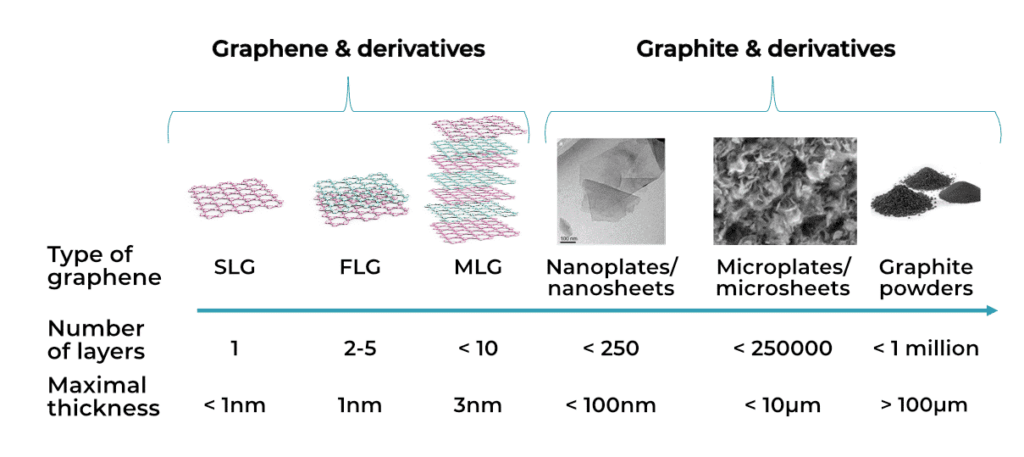
For such a 2D material, thickness is a critical parameter. The thinner the material, the better the properties will be.
Purity of Graphene
Functional groups, even in low quantities, decrease its performance as an anticorrosion agent or thermal and electrical conductor. The degree of functionalization and the level of defects depend greatly on the method of production.
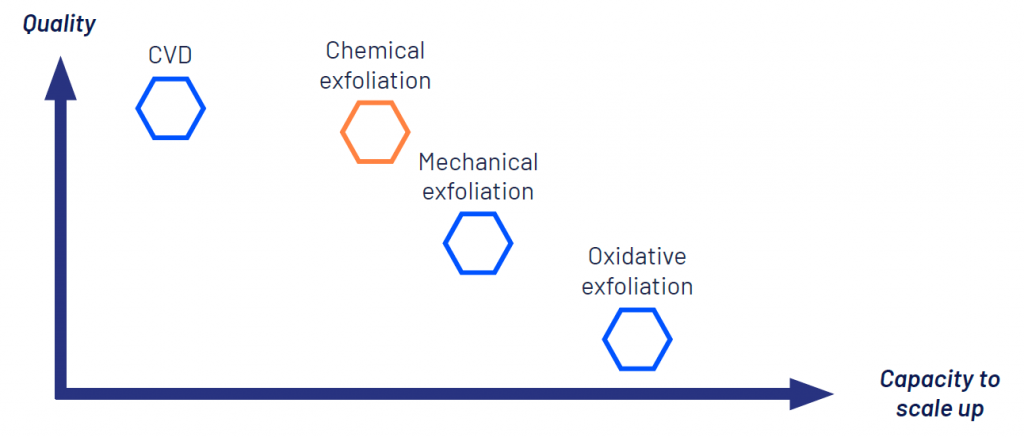
There are five main methods:
Comparing Graphene
When choosing graphene, you should be careful of the quality and scalability of the graphene. It all depends on the application and how you want to use graphene.
Chemical exfoliation: the process
The production of graphene by the chemical exfoliation process results in graphene with few layers (SLG to MLG).
The production route takes advantage of the fact that potassium intercalation compounds dissolve spontaneously in polar solvents.
Advantages and drawbacks
Intercalation of chemical compounds without covalent bonding enables graphene sheets to be separated without introducing functional groups onto the graphene particles.
What’s more, depending on the nature of the intercalation compounds, they can play a stabilizing role, without the need to add surfactants and without altering the properties of graphene. The choice of solvents and intercalation compounds is therefore crucial to obtaining stable, high quality dispersions.
The resulting graphene combines the advantages of the various families of graphene-based materials: high quality while retaining the versatility of a dispersion. Finally, this process can be transposed to industrial scale.
What to remember about the chemical exfoliation process?
This process is currently being industrialized by Carbon Waters, which has mastered this method. The innovation on which its expertise is based enables it to produce stable dispersions, opening up the possibility of using graphene for industrial applications.
Oxidative exfoliation: the process
Also called Hummers’ method, the oxidative exfoliation process is one of the most ancient ones to produce graphene, and is still widely used. Indeed, its industrialization is relatively straightforward, since the industrial technique is well known.
For this exfoliation method, graphite is commonly oxidized under harsh conditions to obtain graphite oxide. This material can be dispersed by sonication in polar solvents, i.e. water, to form graphene oxide (GO) layers.
Advantages and drawbacks
The oxidation introduces a large amount of oxygen containing functional groups which allows the exfoliation and obtention of SLG graphene and ensures the stability in dispersion without the need of further additives.
However, these functional groups interrupt the honeycomb structure of graphene which is responsible for its extraordinary properties. Therefore, this family of graphene materials can have lowered thermal or electrical conductivity. In order to resolve this problem, graphene oxide is most commonly reduced with agents, like hydrazine, or through electrochemical approaches to form so-called reduced graphene oxide (rGO). However, this reduction process is never 100% complete.
What to remember about the process of oxidative exfoliation ?
Even if rGO is still slightly oxidized compared to pristine graphene, it has been used for the development of many applications and has shown its convenience.
The GOs and rGOs available in powder form raise the question of the reaggregation of graphene sheets within these powders, as well as the impact of their use on the respiratory system.
Mechanical exfoliation: the process
This method was first described in 2008 in order to answer the needs for a scalable production process to produce graphene.
This top-down method requires mechanical energy in order to exfoliate graphite. Most commonly, techniques like sonication or high-shear-mixing are utilized. To obtain stable dispersions, it is necessary to add a specific solvent or surfactant.
Advantages and drawbacks
Depending on the process used, mechanical exfoliation leaves very few defects in the graphene, enabling it to maintain its structure and electrical or thermal properties. However, this production method usually leads to a large distribution of graphene flakes in size and thickness.
Moreover, since graphene is hydrophobic by nature, it will tend to reaggregate after dispersion in a solvent. The surfactants or functionalizers chosen therefore play a major role in the stability and final properties of the dispersion. However, the surfactants or solvents used can deteriorate the properties of graphene.
What to remember about the mechanical exfoliation process?
Although this production method is fairly simple to implement, the quality and purity of exfoliated graphene may not be sufficient for specific applications.
The sporting goods industry is always on the lookout for technical innovation that can boost athletic performance. Over the past decade, athletic companies have been working with graphene firms to use this new material to develop a new range of products that will deliver a competitive advantage.
Shoes boosted by graphene
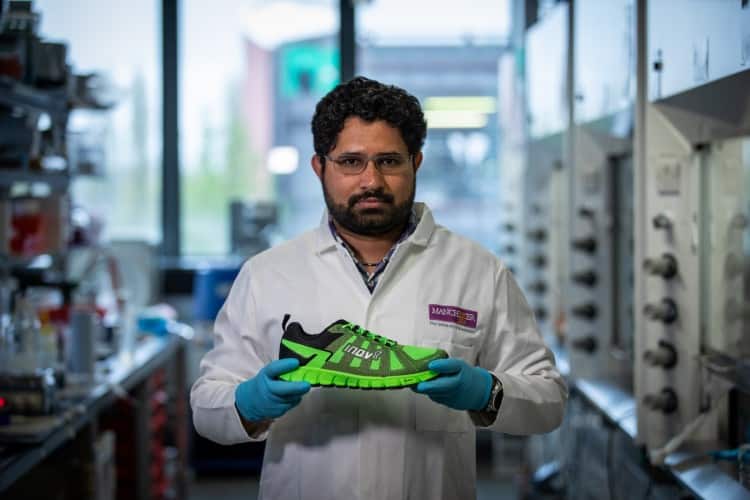 Dr Aravind Vijayaraghavan
Graphene is now known as an amazing material that can be used as an additive in a large range of applications. It exhibits very useful physical, chemical, and mechanical properties, allowing it to substantially improve a material’s performance.
Used as an additive, graphene enhances material performance.
inov-8 is a company that sells high-quality sporting goods to athletes and adventure-seeking hikers. Renowned as the world leader in grip, inov-8 has always sought disruptive technologies to keep their edge. In December 2016, they started to develop a graphene-based rubber for enhancing their grip.
This UK-based company collaborates with the National Graphene Institute and launched the first-ever sports footwear incorporating graphene: G-SERIES and G-GRIP.
With this innovation, they are delivering the world’s toughest grip. According to ASTM, an ISO testing standard for elastomer, this shoe is proven to be 50% tougher, 50% more elastic, and 50% harder-wearing.
This product demonstrates graphene’s ability to significantly improve material performance.
A Showcase for material innovations
Sporting goods are a market where performance is the heart of the business, in particular for companies providing high-quality goods. Graphene’s ability to offer endless possibilities for manufacturing sporting goods leads to major innovations in this sector.
It’s also an opportunity for graphene companies to test their products in order to demonstrate their efficiency in the sporting goods industry.
Like the introduction of carbon fiber, first used in tennis rackets 25 years before being used in aircraft, showcasing graphene performance in the sporting goods industry can speed product time to market and increase credibility.
Moreover, the latest progress in the production process now makes graphene more affordable, with the cost steadily decreasing.
Although this new material seems easy to work with, industrialists still need the advice of experts. Carbon Waters has been working on comparable use cases and now has a complete vision of how graphene can be added to various types of materials to enhance performance.
Currently, research has been focusing mainly on improving high-tech equipment with graphene. We have begun to see the incorporation of graphene in all types of sporting goods used in tennis, skiing, surfing, and cycling.
Endless Possibilities

Why use graphene in sports equipment ?
As seen in the case of athletic shoes, graphene brings better performance in different ways: mechanical resistance, ruggedness, and elasticity. However, graphene is also leading to innovation in lighter and more flexible material as well as in thermoregulated equipment.
Currently, the applications carried out in this sector are only the tip of the iceberg. More and more companies are adding this strategy to their core business, such as inov-8.
Thanks to their innovative shoes boosted by graphene, inov-8 has make a breakthrough in the athletic shoe industry.
That’s why the sporting goods industry has been increasingly interested in graphene. While marketing campaigns show off graphene’s incredible performance, new projects carried out with graphene’s specialists allow for the development of new and better products.
Experts are needed to incorporate graphene into applications. There are different forms of graphene exhibiting different properties.
Global materials specialists met at the IDTechEx Show, on November 20-21, 2019. Among them was Carbon Waters, invited to present its technology.
Several trade shows and conferences attract graphene specialists every year. Among those that focus the most on industrial impacts is the IDTechEx Show.
Organized by a marketing research company specialized in emerging and impactful technologies, IDTechEx, this trade show takes place in Europe in the spring and in the United States in the autumn.
The latest edition, held in Santa Clara on November 20-21, 2019, included 250 booths and 3500 participants—including Alban Chesneau, CEO of Carbon Waters.
IDTechEx invited Carbon Waters to present its technology. I spoke to an audience that included industrial actors and technological experts.
This type of event allows us to publicize our innovations in the field of anticorrosion and material protection to a very international public.”
Ahead of the competition
Three hundred companies were on site to present their solutions at Santa Clara, in the heart of Silicon Valley.
Graphene was the main topic, but printed electronics, energy storage, and MtoM sensors were also discussed.
“During the trade show, I met several European, American, and Japanese companies,” says Alban Chesneau. “We are currently in communication with some of them.” Possibly future partners?
“IDTechEx was also an opportunity to conduct a competition analysis for the sector. And I must say I was reassured: Carbon Waters is keeping its head start! It is interesting, however, to see that large industrial groups such as Ford are already incorporating graphene on a large scale. In this case, in cars and more particularly in polyurethane foams.”
“It’s important to note that graphene makes it possible to significantly improve the mechanical resistance and thermal diffusion of these foams. Then we can replace the metal with a polymer that needs to be reinforced with this material. Graphene can look forward to a prosperous future!” And so can Carbon Waters.
The European consortium NEW SKIN includes 36 organizations and companies, among them Carbon Waters. Our shared goal: finding new nanotechnology-based solutions to improve surfaces.
France, Spain, Austria, Germany, Switzerland, Italy, Romania, and Poland. 36 organizations and companies from these eight European countries have been selected to join the NEW SKIN consortium.
With a budget of over 3 million euros, this program aims to find new solutions to improve surfaces, focusing on two priorities:
1.Metallic surfaces
2.Water filtering
Carbon Waters has received a budget of €100,000 from the consortium to produce graphene dispersion to protect metallic surfaces and reduce corrosion.
“We will produce dedicated formulas based on graphene, and technical and industrial specialists will apply them on certain metallic materials,” explains Alban Chesneau, CEO of Carbon Waters.
“We will focus mainly on steel products for construction. But also on other industrial sectors, such as aeronautics,” adds Chesneau. Thomas Bottein, R&D engineer in charge of surface treatments, will be managing the Carbon Waters project.
Industrial production within two years
The organizations that started the NEW SKIN consortium include the European Steel Association and the European Cluster of Ceramics. The Swedish University of Uppsala, as well as the Israel Institute of Technology, have joined the consortium.
And lastly Alphanov, the Bordeaux technological center, and Aperam, the industrial steel specialist, are also part of the program. The shared goal is to find a protective coating for metals, composites, and ceramics that will last for more than 25 years.
The European program, NEW SKIN, will test 55 prototypes including Carbon Waters’ graphene.
The objective is to achieve industrial production within two years if the project is successful.
Increasing the production
Carbon Waters has recently acquired a reactor to increase the production of its carbonaceous materials and meet industrial demand.
A new milestone reached for Carbon Waters: As of last summer, our company has a laboratory-grade production reactor. This equipment is taking us one step further on our path to scale up the process, allowing us to increase the production of our graphene dispersions.
On one hand, this reactor is essential for developing the proof-of-concept services that we offer to industrial players. On the other hand, it allows us to design our own range of products, particularly for anticorrosion applications.
“We are therefore improving the efficiency of the process to make it compatible with a pre-industrial scale and significantly reduce our lead-times,” summarizes Julia Hof, process manager.
Our production capacity now stands at five liters per month, which is enough graphene dispersion to enrich 100 liters of resin or to treat several square meters of metal. This reactor will enable Carbon Waters to enter a first phase to prepare for future industrial production.
Our plans include several generations of this reactor, additional equipment for quality assessment conducted 100% by Carbon Waters, and environmental controls through a network of sensors as part of an optimized quality approach.
“It also allows us to have a model system for calculation and up-scaling,” explains Julia, who supervised the implementation of this equipment and now manages its use.
A custom reactor
With the arrival of the reactor, we are continuing to optimize parameters to obtain a product with optimum efficiency.
The production of our “eau de graphène” (graphene dispersed in water) requires us to take into account numerous characteristics specific to agitation, the materials and raw materials used… Because while 90% of reactors are standard, ours is at the heart of our technological innovation and is the result of cutting-edge expertise in the field of graphene.
This step represents both great progress in our production program and the know-how needed to achieve patentability.
The next step for Carbon Waters is scheduled for the first half of 2020 with the implementation of an integrated production platform.
It will include several generations of this reactor, additional equipment for quality assessment conducted 100% by Carbon Waters, and environmental controls through a network of sensors as part of an optimized quality approach.
Interview with Thomas Bottein, R&D Engineer, who joined the team in 2019 to work on application developments. “Thrilled to join a start-up that offers numerous challenges”
What led you to join Carbon Waters?
I arrived last February 2019 to help the team meet the growing demand from industrial companies. It fulfilled my wish to become part of a dynamic start-up that offers numerous challenges.
What training have you had?
I am a materials engineer. I graduated from the École Nationale Supérieure de Chimie de Montpellier (French National Graduate School of Chemistry), then went on to obtain my PhD in materials at the University of Marseille, and more specifically at the IM2NP (Institute of Microelectronic, Materials and Nanosciences of Provence, editor’s note).
During my studies, I spent a gap year at Merck, where I worked on thin-layer technologies; and I worked at IBM’s research center in the United States for three months.
I will spare you the exact title of my thesis! In a nutshell, let’s say that I worked on surface treatment and thin layers. My thesis focused on ceramic materials and, more specifically, their optical effects. I am now concentrating on graphene and, in particular, its anticorrosion properties.
What is your role at Carbon Waters?
I am working in the technical team with Julia, Héloïse and Fabien and I am in charge of surface treatments and anticorrosion application. I am starting with “Eau de Graphène” to develop different applications, first related to surface treatment and anticorrosion.
Our customers are typically highly innovative companies, mainly from the aeronautical, electronics, automotive, and space sectors. These studies answer concrete needs, that existing technologies are not fully able to meet, thus requiring cutting-edge application development.
Carbon Waters produces stable dispersions of graphene in water and deposits them on metal surfaces by electroplating; it is the only company in the world to achieve this feat.
The result is a graphene of superior quality, especially for combatting corrosion, according to Charlotte Gallois, innovation manager for Carbon Waters.
What are the properties of graphene?
“Graphene is a sheet of carbon atoms arranged in a honeycomb. This 2D material has very good electrical and thermal conductivity, as well as excellent barrier properties, which make it an excellent protector.
Graphene is used in various applications related to the electrical conductivity of materials (batteries, smartphone touch screens, etc.), heat dissipation (microelectronics), but also material resistance (anticorrosive coating, material for aeronautics, etc.).”
Is Carbon Waters graphene effective against corrosion?
“Completely! Carbon Waters produces a graphene of high good quality, consisting of one to eight sheets of carbon. Carbon Waters is therefore able to protect large areas with small amounts of graphene by making the best use of the barrier properties of this material.
“Carbon Waters graphene is currently used as a surface treatment on steel, aluminum, or nickel in particular. Our graphene is also used as an additive in aqueous or organic formulations to create, for example, anticorrosive coatings.”
Why is Carbon Waters graphene particularly in demand?
“It’s true that we receive a lot of requests from companies. Due to the production process, Carbon Waters graphene is slightly charged, which makes it possible to apply it by electroplating, a technique widely used in many industrial sectors.
“In addition, our product, which comes in liquid form, doesn’t contain organic or volatile compounds, is biodegradable, and complies with European regulations.
“In a context where these same regulations are about to prohibit the use of hexavalent chromium, Carbon Waters graphene is thus an interesting alternative for certain anticorrosion applications. What’s more, graphene is a polyfunctional material, so it’s adapted to meet complex specifications.”